“Does a private cloud have to run in our own data center?” It is a question I often get when talking to customers about Nutanix Cloud Clusters (NC2). I understand why. For years, private cloud and on-prem were used as synonyms. But the term is about something else. Let’s unpack what a private cloud actually is, which constructs it is built on, and why the location of the hardware matters less than you might think.
To spoil the ending: a private cloud is defined by how you operate and consume infrastructure, not by where the servers are racked.
What makes it a cloud?
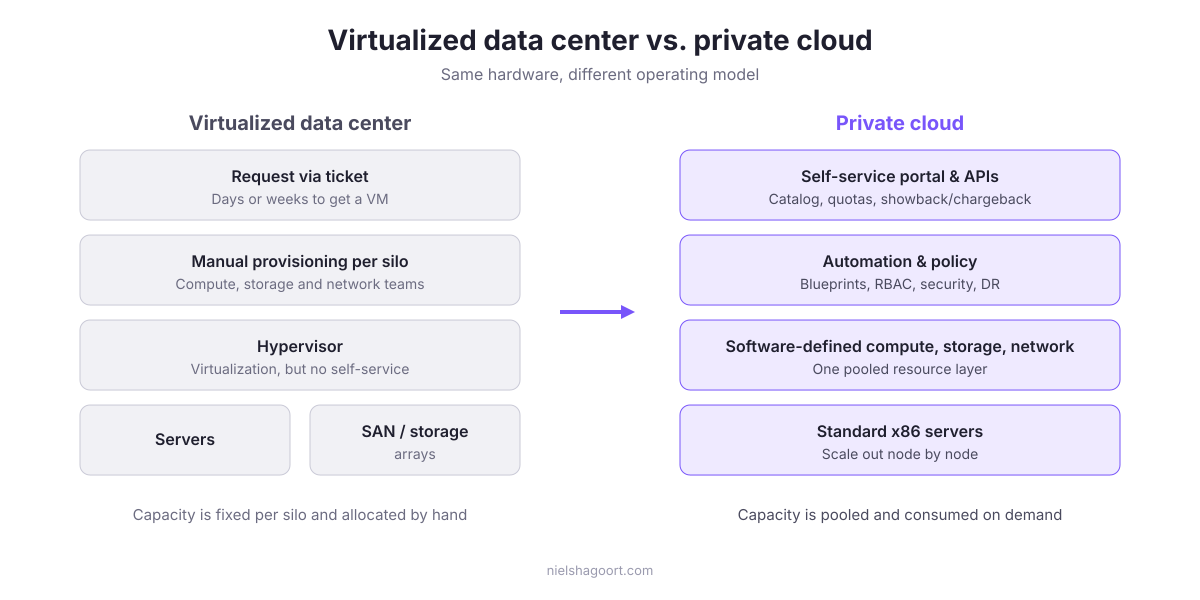
A virtualized data center is not automatically a cloud. Running VMs on a hypervisor is a great start, but if getting a new VM still means filing a ticket and waiting for three different teams, you have virtualization, not a cloud. The NIST definition of cloud computing is still the best yardstick. It lists five essential characteristics:
| Characteristic | What it means in practice |
|---|---|
| On-demand self-service | Consumers provision VMs, K8s clusters or databases themselves, through a portal or API. |
| Broad network access | Services are reachable over the network using standard tooling. |
| Resource pooling | Compute, storage and network are pooled and shared across workloads, instead of being tied to silos. |
| Rapid elasticity | Capacity can grow (and shrink) quickly when demand changes. |
| Measured service | Usage is metered, so you can do showback or chargeback per team or project. |
Notice that none of these characteristics mention a location. It is all about the operating model: software-defined infrastructure, automation, self-service and metering on top.
Private, public and hybrid
With the cloud part covered, the deployment models are fairly simple:
- Private cloud: cloud infrastructure dedicated to a single organization. You are ‘in charge’ of the stack, the data and the policies.
- Public cloud: multi-tenant services offered by a hyperscaler, consumed as a service. You manage what you put on it; the provider manages the rest.
- Hybrid cloud: a combination of both, with the ability to move workloads and data between them in a consistent way.
The keyword in that first bullet is dedicated. Not on-prem.
Private doesn’t mean on-prem
If a private cloud is about a dedicated, cloud-operated stack, it can live in many places. In your own data center, sure. But also on your own hardware in a colocation facility, on dedicated servers at a (sovereign) service provider, or on bare-metal instances in a public cloud.
That last one is where NC2 comes in. With NC2, the Nutanix software stack runs on bare-metal instances in your own AWS, Azure, Google Cloud, or OVHcloud account, inside your own VPC or VNet. These are dedicated physical hosts. There is no other tenant on that hardware, and you run the same AHV hypervisor, storage, and networking constructs you run on-prem. In other words, it is ‘just another’ Nutanix cluster that happens to sit in a hyperscaler data center. The hyperscaler owns the building and the hardware; the private cloud stack is yours.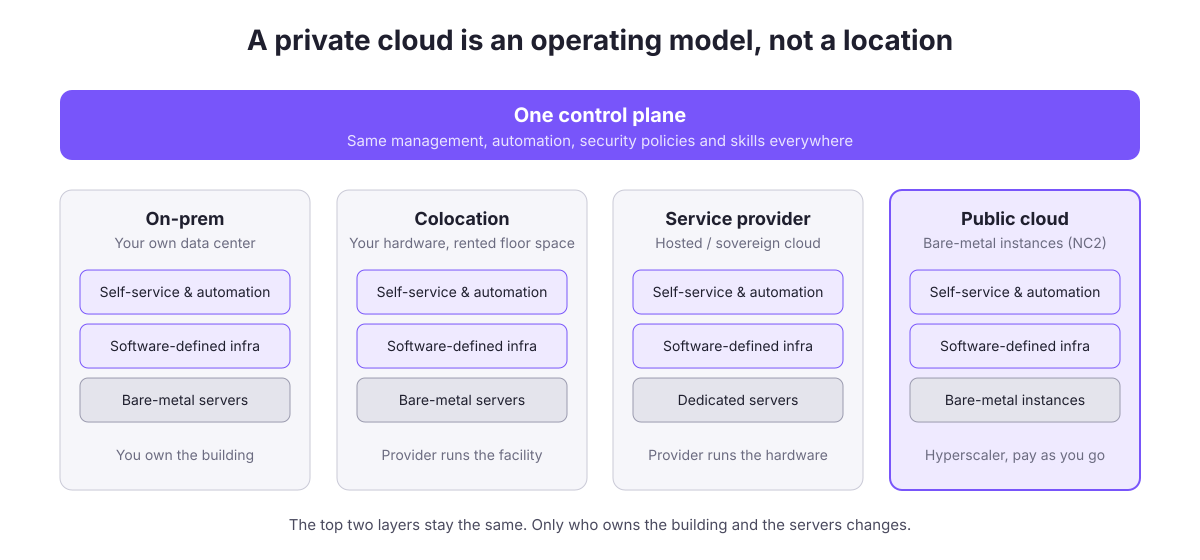
Why hybrid is the answer
Once you decouple the private cloud from the location, the question changes. It is no longer “on-prem or cloud?”, but “where should this workload run today?” A hybrid setup lets you answer that per workload. There are a few drivers I see come back time and again.
1. Operational consistency
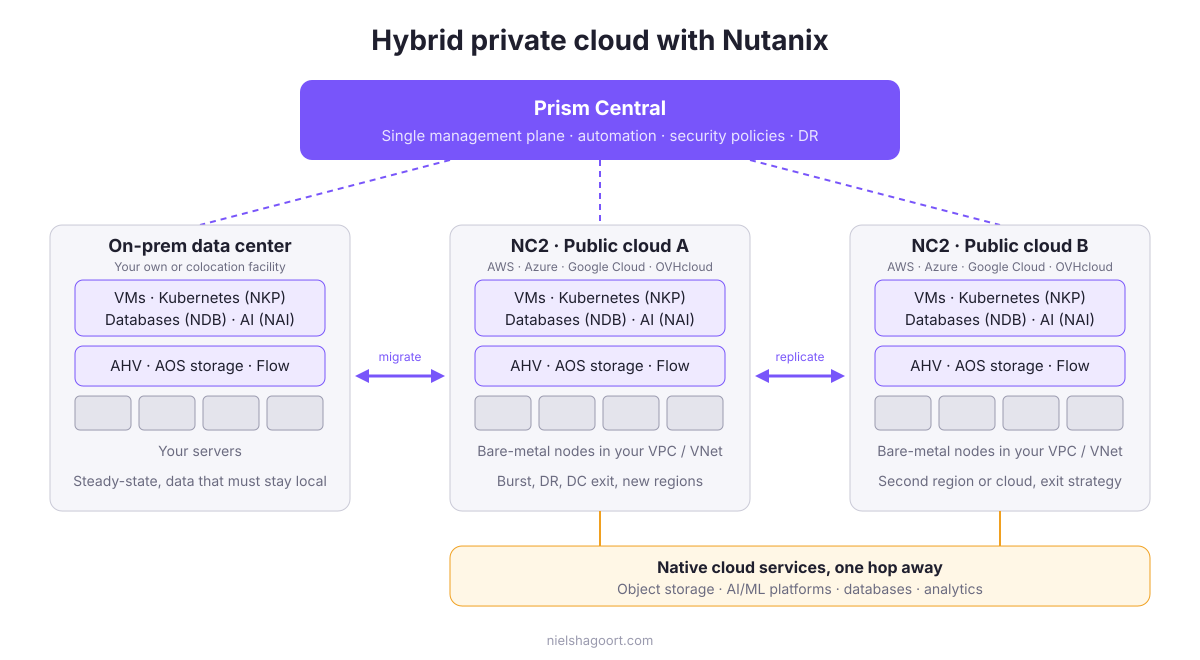
Every additional platform means more tooling, more skills and more runbooks. With the same stack on-prem and in the public cloud, managed from one Prism Central, your teams keep using the same automation, security policies (like microsegmentation with Flow), DR runbooks and monitoring. No refactoring or re-platforming of your VMs either.
2. Data sovereignty and exit strategies
Data sovereignty is top of mind with many customers. Being able to move workloads from on-prem to a public cloud, between public clouds, or back again, gives you control and a real exit strategy. Keep the data that must stay local in your own data center or at a sovereign provider, and run the rest wherever it makes the most sense. Examples of sovereign public clouds are AWS European Sovereign Cloud (ESC), in which Nutanix is a founding partner. NC2 on OVH Cloud is another great option.
3. Elasticity when you need it
Buying hardware for peak capacity or for a DR site that sits idle most of the year is expensive. Adding bare-metal nodes in the public cloud takes far less time than a hardware procurement cycle. Typical use cases are capacity bursts, a DR target, a data center exit, or expanding into a new region without building a new data center.
4. Native services next door
Running in the hyperscaler’s data center puts native services, such as object storage, analytics, and AI platforms, a network hop away. I showed an example of that in my post on integrating NC2 on Google Cloud with Gemini. The same goes for cloud-native workloads: running NKP on NC2 gives you Kubernetes on the same platform as your VMs.
Not everything belongs everywhere
To be fair, hybrid is not a magic wand. The true value of hybrid isn’t blindly moving everything to the cloud or keeping it stranded on-prem—it is having the architectural freedom to place each workload wherever it makes the most financial and operational sense. That is precisely what the Nutanix Cloud Platform delivers: a unified operating model, seamless license portability, and effortless workload mobility, so you never have to pay a migration penalty when your business strategy shifts.
To conclude
A private cloud is a way of operating infrastructure: pooled, automated, self-service and metered, dedicated to you. Where the hardware lives is a separate decision. With the same Nutanix stack on-prem, at a service provider and on bare metal in the public cloud, you get to make that decision per workload. Curious how NC2 is put together? Start with the basics of NC2.